| Last Modified: 06-05-2026 | 6.11:8.1.0 | Doc ID: RM100000001HSSK |
| Model Year Start: 2020 | Model: Corolla | Prod Date Range: [03/2019 - 09/2022] |
| Title: K120 / K121 (CVT): K120 CONTINUOUSLY VARIABLE TRANSAXLE SYSTEM: MECHANICAL SYSTEM TESTS; 2020 - 2022 MY Corolla Corolla Hatchback [03/2019 - 09/2022] | ||
MECHANICAL SYSTEM TESTS
1. SHIFT TIME LAG TEST
NOTICE:
- This test must be performed after checking and confirming that the engine is normal.
- Perform this test with the CVT fluid temperature between 50 and 100°C (122 and 212°F).
- Perform this test with the air conditioning off.
-
w/ Electric Parking Brake System:
Perform this test with the AUTO function (shift-linked function) of the electric parking brake system off.
HINT:
When the shift lever is moved while the engine is idling, there will be a certain time lapse or lag before shock can be felt. This is used for checking the condition of the clutches and brakes.
(a) Connect the Techstream to the DLC3.
(b) Start the engine.
(c) Turn the Techstream on.
(d) Enter the following menus: Powertrain / Transmission / Data List.
Powertrain > Transmission > Data List
(e) Drive the vehicle until the CVT fluid temperature has reached 50 to 100°C (122 to 212°F).
(f) Allow the engine to idle with the air conditioning off.
(g) Apply the parking brake and keep the brake pedal depressed firmly.
HINT:
w/ Electric Parking Brake System:
When the parking brake indicator (red) is illuminated after the electric parking brake switch (electric parking brake switch assembly) has been pulled to the lock side, the maximum amount of braking force is applied if the electric parking brake switch (electric parking brake switch assembly) is pulled to the lock side one more time.
(h) Check the D position time lag.
(1) Move the shift lever to N and wait for 1 minute.
(2) Move the shift lever to D and measure the time until shock is felt.
(3) Repeat the 2 steps above 3 times, and calculate the average time of the 3 tests.
Standard Value:
D position time lag is less than 1.2 seconds.
(i) Check the R position time lag.
(1) Move the shift lever to N and wait for 1 minute.
(2) Move the shift lever to R and measure the time until shock is felt.
(3) Repeat the 2 steps above 3 times, and calculate the average time of the 3 tests.
Standard Value:
R position time lag is less than 1.5 seconds.
2. STALL SPEED TEST
CAUTION:
-
Do not perform a stall test if there are any people or objects near the vehicle.
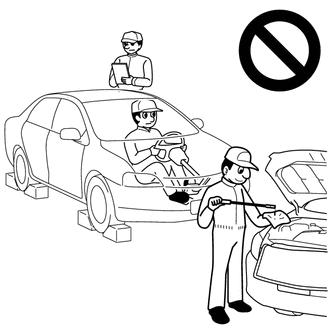
- The vehicle could begin moving suddenly, resulting in a serious accident.
-
Do not perform a stall test if any wheel chocks are out of position.
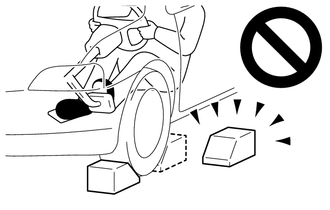
- The vehicle could begin moving suddenly, resulting in a serious accident.
-
Do not perform the stall test on a slippery or low-friction surface that could allow the tires to spin.
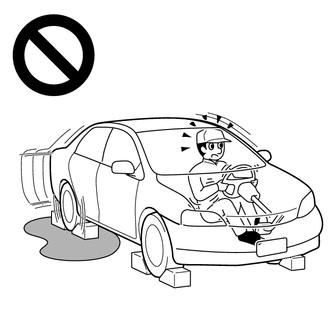
- The vehicle could begin moving suddenly, resulting in a serious accident.
NOTICE:
- Do not perform a stall speed test for more than 5 seconds.
- When performing the stall speed test repeatedly, wait for 15 seconds or more between tests.
-
w/ Electric Parking Brake System:
Perform this test with the AUTO function (shift-linked function) of the electric parking brake system off.
HINT:
This test is used to check the overall performance of the engine and transaxle.
(a) Connect the Techstream to the DLC3.
(b) Start the engine.
(c) Turn the Techstream on.
(d) Enter the following menus: Powertrain / Transmission / Data List.
Powertrain > Transmission > Data List
(e) Drive the vehicle until the CVT fluid temperature has reached 50 to 100°C (122 to 212°F).
(f) Allow the engine to idle with the air conditioning off.
(g) Chock all 4 wheels.
(h) Enter the following menus: Powertrain / Transmission / Active Test / Activate the TC Terminal.
Powertrain > Transmission > Active Test
(i) Apply the parking brake and firmly depress the brake pedal with your left foot.
HINT:
w/ Electric Parking Brake System:
When the parking brake indicator (red) is illuminated after the electric parking brake switch (electric parking brake switch assembly) has been pulled to the lock side, the maximum amount of braking force is applied if the electric parking brake switch (electric parking brake switch assembly) is pulled to the lock side one more time.
(j) Move the shift lever to D.
(k) Depress the accelerator pedal as much as possible with your right foot.
(l) Quickly read the engine speed (stall speed) and release the accelerator pedal immediately.
Stall Speed:
2350 +/- 300 rpm
3. INSPECT BELT FUNCTION
CAUTION:
-
Strictly observe posted speed, limits, traffic laws and road conditions.
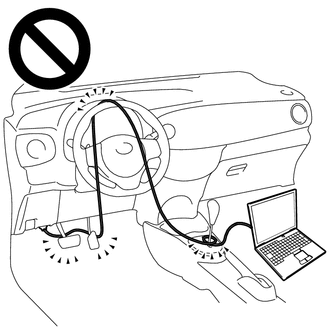
- Do not drive the vehicle with the cable of the GTS contacting the pedals, shift lever or steering wheel.
- Driving the vehicle with the cable of the GTS contacting these areas could impede vehicle control, resulting in a serious accident.
-
Do not operate the GTS while driving the vehicle.
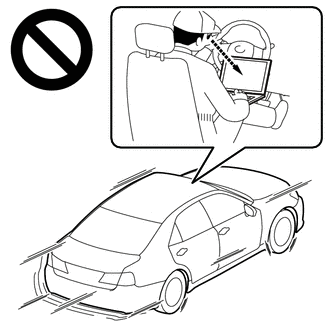
- Operating the GTS while driving the vehicle will prevent you from paying sufficient attention to vehicle surroundings, and could result in a serious accident.
NOTICE:
- This test must be performed after checking and confirming that the engine is normal.
- Perform this test with the CVT fluid temperature between 50 and 100°C (122 and 212°F).
- Perform this test with the air conditioning off.
(a) Start the engine.
(b) Warm it up until the CVT fluid temperature is 50 to 100°C (122 to 212°F).
Powertrain > Transmission > Data List
(c) Allow the engine to idle with the air conditioning off.
(d) Enter the following menus.
Powertrain > Transmission > Data List
(e) Accelerate the vehicle with the accelerator opening angle at 10%, and confirm that the vehicle speed exceeds 20 km/h while the engine speed remains at 2000 rpm or less.
HINT:
-
The illustration shows the state of the Data List when the CVT belt is functioning correctly.
-
The vehicle speed exceeds 20 km/h.
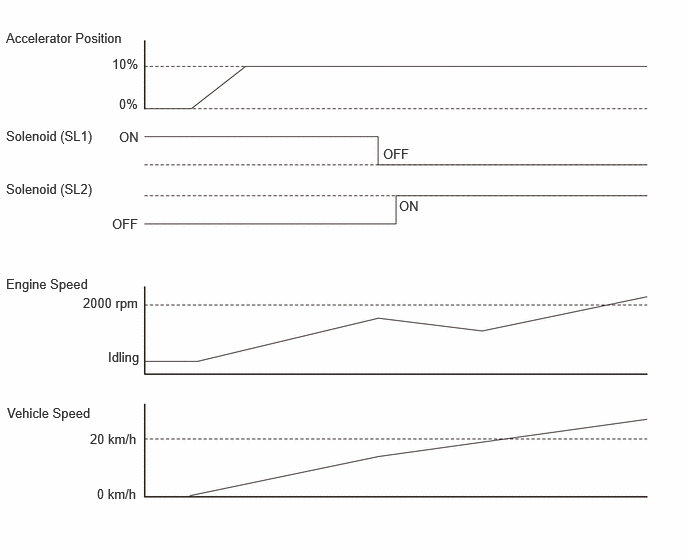
-
The vehicle speed exceeds 20 km/h.
-
The illustration shows the state of the Data List when the CVT belt is broken or slipping.
- With Solenoid (SL1) OFF and Solenoid (SL2) ON, the engine speed exceeds 2000 rpm.
-
The driving force decreases, and the vehicle speed does not exceed 20 km/h.
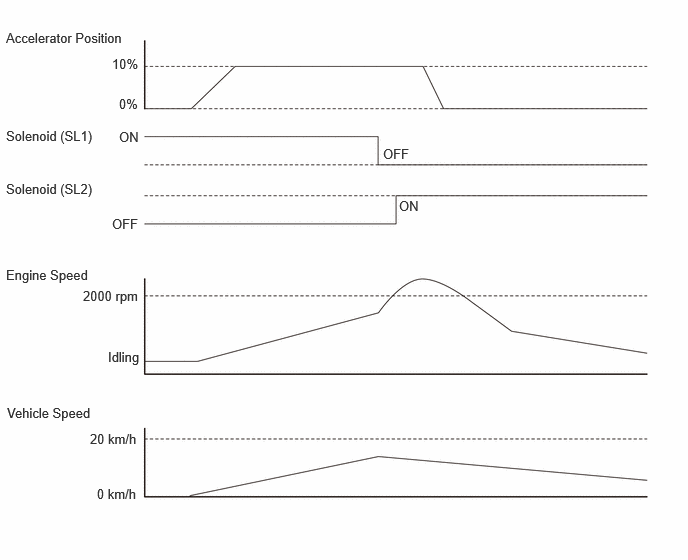

|

|